Case study 02 / 05
Honours thesis, Wilfrid Laurier University
Gamification & Flow State
For my honours thesis I ran a 10-day diary study comparing Duolingo and Khan Academy. Gamification is everywhere, but I wanted to know which mechanics actually keep people motivated and absorbed in what they’re learning.
- My role
- Independent Researcher
- Supervisor
- Dr. Maurita Harris
- Timeline
- 8 months, 2024–2025
- Methods
- Diary study, pre/post surveys, thematic analysis
- Tools
- Qualtrics, Excel
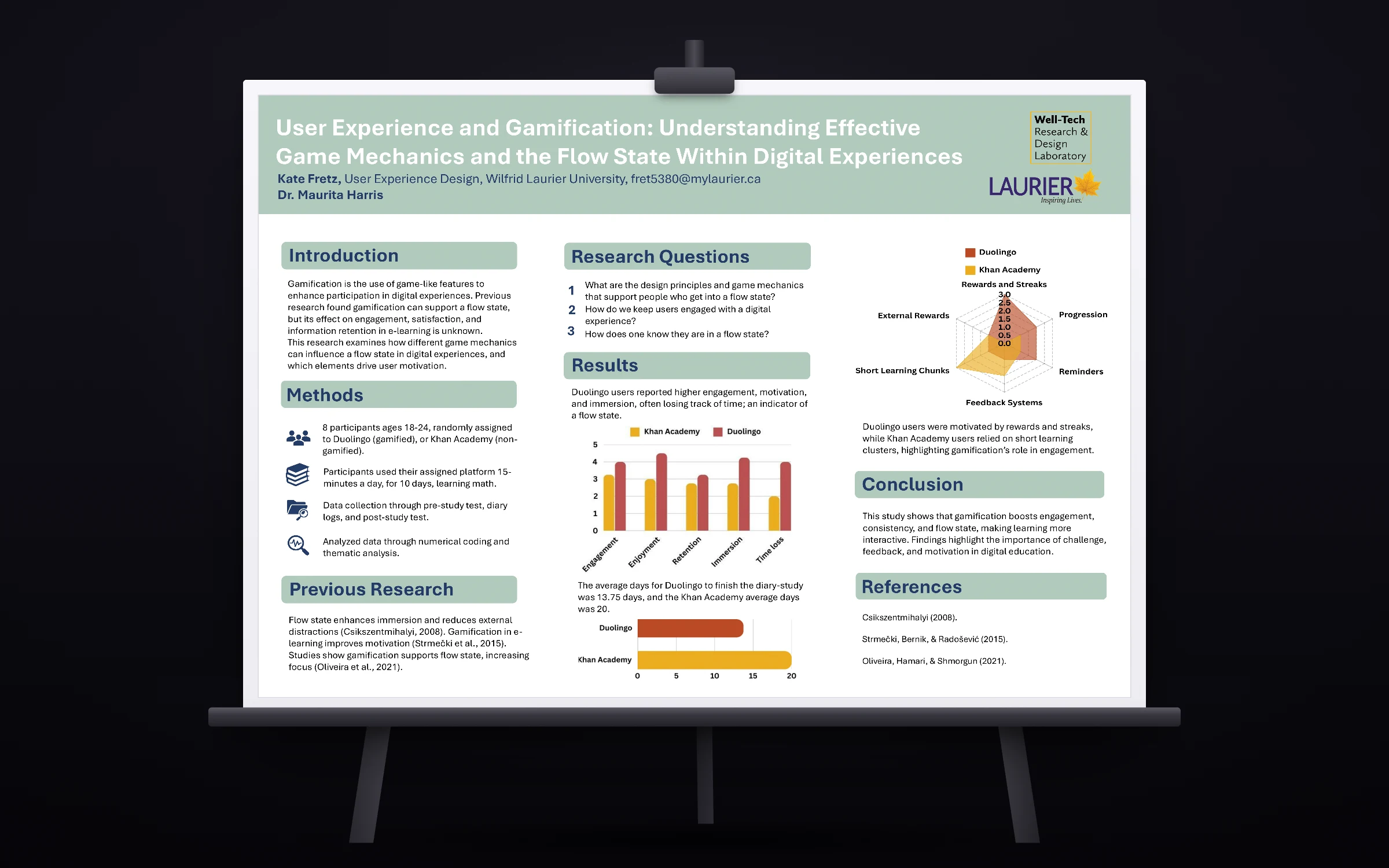
At a glance
The problem
Learning, fitness and productivity apps all use points, streaks and badges, but there’s little research on which specific mechanics help people stay motivated and reach a flow state.
My part
I ran the whole study on my own: the research questions, literature review, study design, recruiting, surveys, analysis, the thesis and the poster.
What happened
Duolingo participants reported higher engagement and finished the study faster. I presented the poster at Laurier’s research showcase (ACERS) in 2025, where it was recognized.
4.6/5
Enjoyment (gamified)
13.75
Days to finish vs 20
8
Study participants
With eight participants, these results are directional. They point to patterns worth testing at a larger scale.
Problem: Which game mechanics actually help people learn?
Gamification is a popular strategy across education, fitness and productivity products. But there’s still limited research on which specific mechanics help people stay motivated, engaged and immersed over time, and which are just decoration.
My literature review found a gap: gamification and flow state are usually studied separately. Few studies look at how particular mechanics contribute to flow in real learning platforms people actually use.
My research questions
- RQ1
What game mechanics and design principles support people in reaching a flow state?
- RQ2
How can digital experiences keep people engaged over time?
- RQ3
How can we tell when someone has entered a flow state in a digital experience?
The theory behind it
- Flow state
- Csikszentmihalyi’s idea of deep immersion: focus, losing track of time and a sense of control.
- Gamification
- Game-like features such as points, streaks, rewards, feedback and progress tracking.
- Self-Determination Theory
- Motivation that comes from autonomy, competence and relatedness.
Approach: Ten days, two apps, eight people.
I randomly assigned eight participants, aged 18 to 24, to either Duolingo or Khan Academy. Each spent 15 minutes a day learning math for 10 days, remotely, and logged how it went. I chose the two apps because one leans heavily on game mechanics and the other mostly doesn’t.
- Duolingo (gamified)
- Rewards, streaks, progress tracking, reminders and interactive challenges.
- Khan Academy (non-gamified)
- Instructional videos, short quizzes, structured lessons and feedback.
How I collected and analysed the data
Pre-study survey
Each participant’s background and baseline experience.
Daily diary logs
Engagement and consistency across all 10 days.
Post-study survey
Satisfaction, motivation, perceived retention, immersion, time loss and other signs of flow.
Analysis
I coded the Likert responses numerically and ran a thematic analysis on the open-ended answers.
Insights: The gamified group was more engaged, and more consistent.
Two differences were measurable. The open-ended answers explained them.
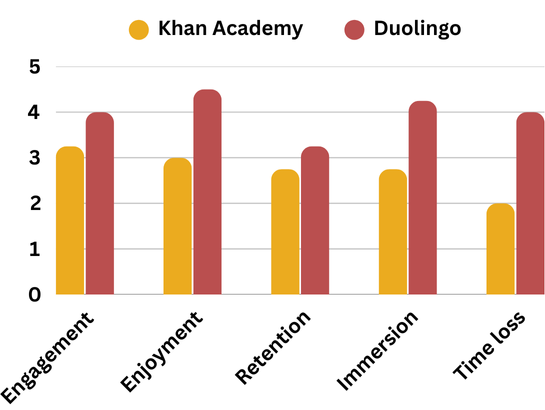
- 4.0
Average engagement on Duolingo, against 3.25 on Khan Academy
The gamified group rated their engagement higher, which suggests game mechanics help people stay focused and keep interacting.
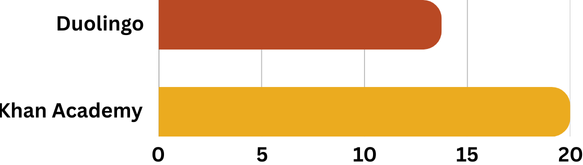
- 13.75
Days to finish the 10 sessions on Duolingo, against 20 on Khan Academy
The gamified group got through the study faster on average, which suggests the game mechanics helped with consistency and momentum.
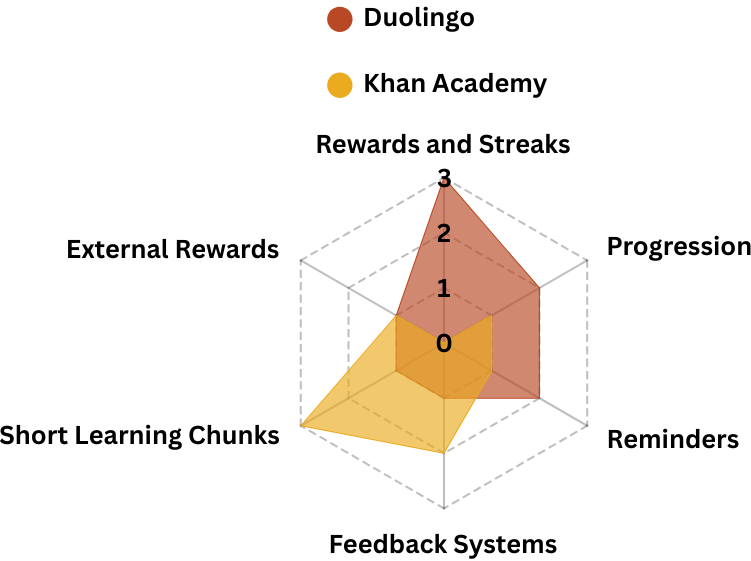
Rewards and streaks were the biggest motivators for the Duolingo group, along with progress tracking and reminders. Khan Academy participants leaned more on short lessons and feedback.
Duolingo participants also reported stronger signs of flow: more immersion, losing track of time, tasks feeling effortless, and feeling in control of their learning.
The motivation was emotional, not only functional. The game features made people enjoy the experience, which made them more likely to keep going.
Design: What this means if you’re designing for motivation.
The results suggest gamification works when it’s part of the core experience, not a layer of points added at the end. These are the mechanics I’d reach for first:
- Clear progression, so people can see where they are and what’s next.
- Immediate feedback after every action.
- Rewards that mean something, rather than points for the sake of points.
- Challenge that matches skill, which is what keeps people in flow.
- Streaks or other habit-building mechanics.
- Visible markers of what someone has accomplished.
- Motivation systems people can personalize.
None of this is specific to language or math apps. The same principles apply to onboarding flows, productivity tools, wellness and fitness apps, loyalty programs and AI products.
Outcome: A thesis, a poster and a talk.
I wrote up the study as my honours thesis and presented the poster at Laurier’s Academic, Creative and Engaged Research Showcase (ACERS) in 2025, where it received recognition.
Reflection: The numbers showed what happened. Participants explained why.
This was the first study I led from start to finish. It’s where I built my research skills: study design, recruiting, survey writing, analysis, academic writing and presenting.
The biggest lesson was to pair numbers with people’s own words. The survey scores showed a difference in engagement, but it was the open-ended answers that explained it.
What I’d change next time
- Recruit more than eight participants, and beyond ages 18 to 24.
- Run it for longer than 10 days.
- Test retention objectively instead of asking people how much they remembered.
- Account for the other ways Duolingo and Khan Academy differ (interface, tone and lesson structure), not just gamification.
- Look at whether AI personalization could support motivation and flow.